Assessing Our Alfalfa Field Management Post 1st Cut

First cut haylage is in the bag – maybe quite literally for some of us! Now is a great chance to review the results of our efforts in our largest cut of the year and see what can be improved. Before we make wholesale changes to our alfalfa management, it’s important to understand what is within our control and what isn’t.
Yield can be the first metric we consider. If we are unhappy with our yield this year there’s a few things to consider:
Total rainfall. The amount of rainfall has a huge influence on the yield potential of a cut. We would see this in historical trends when we compare our 1st cut to our 2nd cut. 1st often yields more because of the moisture through the spring.
Fertility management. Are we applying fertilizer to these fields, arguably some of the hardest working on the farm?
We might have a quality test back by now that we can look at as well.
Total rainfall. Rainfall plays a significant role in our quality as well. Above average rainfall will result in a decrease in quality – notably fibre digestibility and % protein – as evidenced in this graphic from the University of Wisconsin.

Rainfall Impact on Forage Quality https://fyi.extension.wisc.edu/forage/files/2017/04/FQ.pdf Harvest timing. The stage of plant development when we harvest is one of the largest influencers of final quality. The table below from PennState Extension highlights how forage digestibility declines as the grasses progress through their development.
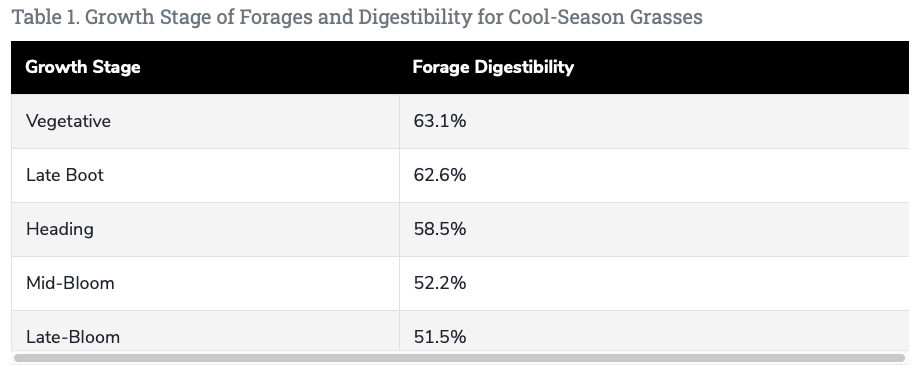
Cool Grass Growth Stages and Fibre Digestibility Results https://extension.psu.edu/first-cut-forage-considerations Plant Health. The amount of healthy tissue in a plant certainly impacts the amount of feed quality there is. As a plant’s leaf tissue deteriorates either because of cannibalization of fertility or through a leaf disease, it leaves behind a higher % of uNDF.
Understanding some key metrics and their influencers, we can now look at what management factors we need to focus on to achieve our desired results. It should stand out to you that rainfall is a very large influencer of both quality and yield, and yet it is likely beyond our control. We can use that knowledge to properly gauge our success year over year, and also use other tools like harvest timing to strive for the same quality goals.
Fertilize, fertilize, fertilize! We when remove the whole plant from the field, we are taking all the nutrients it drew out of the soil with it as evidenced by the OMAFA graphic below. If using manure, remember that it has a large part of what our forages need but is not perfectly balanced. Look into adding in some commercial fertilizer either in the spring or after 1st cut as a top up. Soil testing and working with an agronomist will help you tailor your nutrient needs, just like our nutritionists do for our milking herds.

Nutrient Removal of Alfalfa https://www.ontario.ca/files/2022-10/omafra-guide-to-forage-production-en-2022-10-19.pdf Consider the impact of your seeding mixture. Adding grasses into the mix can help thicken stands, especially if we have areas that are challenging alfalfa survival, but they can complicate harvest timing. When looking at the ideal time to harvest, base it on the as harvested mixture of your field, not the as planted. Often in 1st cut, grasses have an opportunity to come ahead and boost yield – but also having a larger influence on quality as well. Grasses are OK to include but be honest if they’re having a negative impact on your 1st cut.
As usual, the work that we do at harvest matters to maintain the quality realized in the field. Proper harvest moisture, good packing in storage and considering the use of an inoculant are all tools we have to help make sure that our high-quality feed going into storage, comes out as high quality in a few month’s time. If you have any questions about how to improve your forage quality or yield, contact us today.


Comments